
Times Tables Grid 1–12 | Free Printable Chart & Parent Guide
Last updated: 29 August 2026
Times tables are the building blocks of maths. Once children know their multiplication facts fluently, everything from long division to fractions and algebra becomes much easier. This guide covers everything parents need to know — including when children learn each times table, how to help them practise at home, and what to expect from the Year 4 Multiplication Tables Check.
Times Tables Grid 1–12
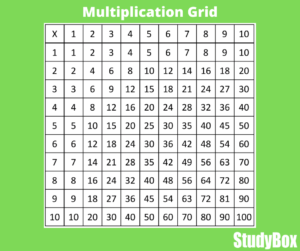
Here is the full times tables grid from 1 to 12. You can use this as a reference chart or print it out and display it somewhere visible at home.
| × | 1 | 2 | 3 | 4 | 5 | 6 | 7 | 8 | 9 | 10 | 11 | 12 |
|---|---|---|---|---|---|---|---|---|---|---|---|---|
| 1 | 1 | 2 | 3 | 4 | 5 | 6 | 7 | 8 | 9 | 10 | 11 | 12 |
| 2 | 2 | 4 | 6 | 8 | 10 | 12 | 14 | 16 | 18 | 20 | 22 | 24 |
| 3 | 3 | 6 | 9 | 12 | 15 | 18 | 21 | 24 | 27 | 30 | 33 | 36 |
| 4 | 4 | 8 | 12 | 16 | 20 | 24 | 28 | 32 | 36 | 40 | 44 | 48 |
| 5 | 5 | 10 | 15 | 20 | 25 | 30 | 35 | 40 | 45 | 50 | 55 | 60 |
| 6 | 6 | 12 | 18 | 24 | 30 | 36 | 42 | 48 | 54 | 60 | 66 | 72 |
| 7 | 7 | 14 | 21 | 28 | 35 | 42 | 49 | 56 | 63 | 70 | 77 | 84 |
| 8 | 8 | 16 | 24 | 32 | 40 | 48 | 56 | 64 | 72 | 80 | 88 | 96 |
| 9 | 9 | 18 | 27 | 36 | 45 | 54 | 63 | 72 | 81 | 90 | 99 | 108 |
| 10 | 10 | 20 | 30 | 40 | 50 | 60 | 70 | 80 | 90 | 100 | 110 | 120 |
| 11 | 11 | 22 | 33 | 44 | 55 | 66 | 77 | 88 | 99 | 110 | 121 | 132 |
| 12 | 12 | 24 | 36 | 48 | 60 | 72 | 84 | 96 | 108 | 120 | 132 | 144 |
Tip: Notice that 3 × 4 gives the same answer as 4 × 3. This means once your child knows one fact, they already know the reverse — cutting the total number of facts to memorise nearly in half.
When Do Children Learn Their Times Tables?
The UK national curriculum sets out clear expectations for each year group:
- Year 1 (ages 5–6): Count in multiples of 2, 5 and 10. No formal times tables yet, but children build the foundations through skip counting and doubling.
- Year 2 (ages 6–7): Learn the 2, 5 and 10 times tables. Children should be able to recall these facts and use them for simple multiplication and division.
- Year 3 (ages 7–8): Learn the 3, 4 and 8 times tables, in addition to those from Year 2.
- Year 4 (ages 8–9): Know all times tables up to 12 × 12 by heart. This is the year of the Multiplication Tables Check (see below).
- Years 5–6 (ages 9–11): Continue to practise for speed and accuracy, and apply times tables knowledge to long multiplication, division, fractions and problem solving.
The Year 4 Multiplication Tables Check (MTC)
Since 2022, all Year 4 pupils in state-funded schools in England take the Multiplication Tables Check (MTC) in June. Here’s what parents need to know:
- Format: An online test with 25 multiplication questions.
- Time limit: Children have 6 seconds to answer each question, with a 3-second pause between questions. The whole test takes about 5 minutes.
- Range: Questions cover times tables from 2 × 2 up to 12 × 12, with more questions on the harder tables (6, 7, 8, 9 and 12).
- Scoring: Out of 25. There is no official pass mark — the check is designed to be diagnostic, not punitive.
- 2026 dates: The MTC window runs from Monday 1 June to Friday 12 June 2026.
- Results: Schools share your child’s score with you. The national average in 2025 was 21 out of 25.
The best way to prepare is regular, short practice sessions — little and often works better than long cramming sessions.
8 Tips for Learning Times Tables at Home
1. Start Small and Build Up
Begin with the easier tables (2s, 5s, 10s) and work up to the harder ones. Once your child knows the 2 times table, double it for the 4 times table, then double again for 8. This builds confidence and shows how the tables connect.
2. Use a Times Tables Grid
Create a 12 × 12 grid together or print one out. Practise filling in the blanks, or cover certain squares and test recall. Display it somewhere visible — the fridge, a bedroom wall, or next to the desk.
3. Colour Code Each Table
Assign a different colour to each times table. This helps visual learners spot patterns and makes the grid less overwhelming. Highlight matching pairs (e.g. 3 × 4 and 4 × 3 in the same colour) to show that learning one fact gives you two for free.
4. Look for Patterns
Every times table has patterns that make it easier to remember:
- 9 times table: The digits always add up to 9 (e.g. 18 → 1+8=9, 27 → 2+7=9). The tens digit goes up while the units digit goes down: 9, 18, 27, 36, 45…
- 5 times table: Always ends in 0 or 5. You can also halve the 10 times table.
- 11 times table: Up to 9 × 11, just repeat the digit (11, 22, 33… 99).
- Odd × odd = odd, even × anything = even.
5. Make Flash Cards
Write the question on one side and the answer on the other. Shuffle and test daily. Start with the ones your child finds hardest and gradually add easier ones. Flash cards are portable — perfect for practising in the car or before bed.
6. Use Songs and Rhymes
Musical multiplication — whether it’s a catchy YouTube video or a made-up rhyme — uses a different part of the brain. Many children remember “5, 6, 7, 8… 56 is 7 × 8” more easily than the raw numbers.
7. Practise Little and Often
Five minutes of daily practice is far more effective than an hour once a week. Consistency builds long-term memory. Try testing a few facts at breakfast, in the car, or before bedtime.
8. Make It a Game
Turn practice into a challenge rather than a chore:
- Beat the clock: How many facts can they get right in 60 seconds?
- Dice games: Roll two dice and multiply the numbers.
- Online apps: Times Table Rock Stars and Hit the Button are popular with children.
- Scavenger hunt: “Find 3 × 4 green leaves in the garden!”
The Hardest Times Tables — and How to Tackle Them
Research shows that the 7 times table is the hardest for most children, followed by 8 and 6. This is because 7 is a prime number, so the multiples don’t follow obvious patterns.
By Year 4, most children have already learned their 2s, 3s, 4s, 5s and 10s — so the “new” facts to memorise are actually quite few. The trickiest ones tend to be:
- 6 × 7 = 42
- 6 × 8 = 48
- 7 × 8 = 56
- 7 × 9 = 63
- 8 × 9 = 72
- 12 × 7 = 84
- 12 × 8 = 96
Focus extra practice on these — if your child knows the harder facts, the rest will come easily.

Why Times Tables Matter Beyond Primary School
Times tables aren’t just for primary school tests. Fluent recall helps with:
- Fractions: Finding common denominators, simplifying, and multiplying fractions
- Long division: Every step of division requires a times tables fact
- Algebra: Factorising and expanding brackets at GCSE
- Mental maths: Quicker problem-solving in exams and everyday life
- 11+ preparation: Speed and accuracy in the maths and non-verbal reasoning sections
Investing time in times tables now pays dividends for years to come.
Need Extra Help?
If your child is finding times tables a challenge, our experienced maths tutors can help them build fluency and confidence through personalised, step-by-step support.
We offer maths tuition for ages 5–17, covering everything from basic times tables to GCSE preparation.
Book a free trial at one of our tuition centres in Wallington, Sutton or Croydon, or call us on 0203 189 1442.
