
How to make multiplying fractions easy

Last updated: 28 August 2026
Multiplying fractions is one of the most common topics in primary and GCSE maths — and once you understand the method, it’s actually one of the easiest fraction operations to get right. This guide breaks it down step by step, with clear examples for proper fractions, whole numbers and mixed numbers.
How to Multiply Fractions: The 3-Step Method
The basic rule for multiplying fractions is simple:
- Multiply the numerators (the top numbers) together.
- Multiply the denominators (the bottom numbers) together.
- Simplify the fraction if possible.
That’s it — unlike adding or subtracting fractions, you don’t need to find a common denominator first.
Worked Example: Multiplying Two Proper Fractions
Let’s try 1/2 × 1/3:
- Step 1: Multiply the numerators: 1 × 1 = 1
- Step 2: Multiply the denominators: 2 × 3 = 6
- Step 3: The answer is 1/6 — this can’t be simplified further.

Here’s another: 2/3 × 4/5:
- Numerators: 2 × 4 = 8
- Denominators: 3 × 5 = 15
- Answer: 8/15 (already in its simplest form)
How to Multiply Fractions by a Whole Number
To multiply a fraction by a whole number, turn the whole number into a fraction by putting it over 1. Then multiply as normal.
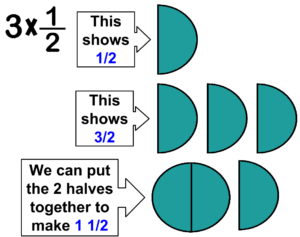
Example: 3 × 2/5
- Rewrite 3 as 3/1
- Numerators: 3 × 2 = 6
- Denominators: 1 × 5 = 5
- Answer: 6/5, which is 1 and 1/5 as a mixed number.
How to Multiply Mixed Numbers
Mixed numbers (like 1½ or 2¾) need to be converted into improper fractions before you can multiply them.
To convert a mixed number to an improper fraction:
- Multiply the whole number by the denominator.
- Add the numerator.
- Put the result over the original denominator.
Example: 1½ × 2¼
- Convert 1½ → (1 × 2 + 1) / 2 = 3/2
- Convert 2¼ → (2 × 4 + 1) / 4 = 9/4
- Now multiply: 3/2 × 9/4
- Numerators: 3 × 9 = 27
- Denominators: 2 × 4 = 8
- Answer: 27/8 = 3 and 3/8
How to Simplify Your Answer
Always check if your answer can be simplified by dividing both the numerator and denominator by their highest common factor.
Example: 2/4 × 3/6
- Numerators: 2 × 3 = 6
- Denominators: 4 × 6 = 24
- Answer: 6/24
- Both 6 and 24 divide by 6, so: 6/24 = 1/4
Top tip: You can also simplify before you multiply (called cross-cancelling). In the example above, you could cancel the 2 and 6 diagonally, and the 3 and 4 diagonally — making the multiplication easier.
The Visual Method: Drawing Fractions
Multiplying fractions can be made easier by drawing out the values. This makes the concept visible and is especially helpful for younger children.
Draw a rectangle, divide it into columns for the first fraction and rows for the second. The overlapping shaded area shows the answer. For 1/2 × 1/3, you’d shade half the columns and a third of the rows — the overlap is 1 out of 6 sections, confirming the answer is 1/6.
Common Mistakes to Avoid
- Adding instead of multiplying: Some children mix up the rules and try to find a common denominator. For multiplication, just multiply straight across — top × top, bottom × bottom.
- Forgetting to simplify: Always check if the answer can be reduced to its simplest form.
- Not converting mixed numbers: You must convert mixed numbers to improper fractions before multiplying.
- Confusing numerator and denominator: The numerator is always the top number, and the denominator is always the bottom number.
Practice Problems
Try these yourself — answers are below:
- 1/3 × 1/4 = ?
- 2/5 × 3/7 = ?
- 4 × 2/3 = ?
- 1½ × 2/3 = ?
- 2¼ × 1⅓ = ?
Answers:
- 1/12
- 6/35
- 8/3 (or 2⅔)
- 1 (3/2 × 2/3 = 6/6 = 1)
- 3 (9/4 × 4/3 = 36/12 = 3)
When Do Children Learn to Multiply Fractions?
In the UK national curriculum:
- Year 5: Children begin multiplying proper fractions and mixed numbers by whole numbers.
- Year 6: Children learn to multiply simple pairs of proper fractions, writing the answer in its simplest form (e.g. 1/4 × 1/2 = 1/8).
- KS3 and GCSE: Multiplying fractions becomes more complex, including mixed numbers, algebraic fractions and multi-step problems.
If your child is struggling with multiplying fractions — or any area of maths — our expert Maths tutors can help build their confidence with personalised, step-by-step support.
Related Reading
- Equivalent Fractions Explained
- How to Subtract Fractions
- How to Help Your Child with Maths at Home
- Learning Times Tables
- How to Subtract Fractions in 3 Simple Steps
- Equivalent Fractions Explained
Book a free trial at one of our tuition centres in Wallington, Sutton or Croydon, or call us on 0203 189 1442.
