Category Archives for "Blog"
Posts that have edge-case related tests

Posts that have edge-case related tests
11 Plus tuition at StudyBox costs £60 for a two-hour session, covering Maths, English and reasoning skills together, at our Croydon, Sutton and Wallington centres. There are no joining fees or long-term contracts, and every family can start with a free trial session.
Our 11 Plus sessions run for two hours and combine three core areas that make up most grammar school and independent school entrance exams:
Most families start in Year 4 or early Year 5, giving 12–18 months of steady, weekly preparation before the exams (typically September of Year 6 for most South London grammar schools). Starting early means sessions can stay relaxed and build genuine understanding, rather than last-minute cramming, which tends to increase exam stress rather than reduce it.
Many of our 11 Plus pupils are preparing for entrance exams at schools such as Sutton Grammar School and Wallington County Grammar School, so our tutors know the exam format and competition level at these schools well.
StudyBox runs 11 Plus tuition at three centres across South London:
Each centre offers the same two-hour, £60 format, in small groups of no more than 3 students per tutor.
The clearest sign your child needs extra help with GCSE Science is when test scores drop below their normal average across two or more topics, or when they say they “don’t understand” a lesson but can’t say why. Catching this early — rather than waiting for a mock exam result — makes it far easier to close the gap before Biology, Chemistry or Physics content builds up further.
At StudyBox, our GCSE Science tuition covers Biology, Chemistry and Physics for students in Year 7 to Year 11, in small groups of no more than 3 per tutor. We start with a short assessment to identify which specific topics and exam skills need the most attention, then build a session plan around your child’s exam board and upcoming assessments.
Sessions are £30 each, with no joining fees or long-term contracts. We run GCSE Science tuition at our Croydon, Sutton and Wallington centres.
We regularly support pupils from schools including Shirley High School and Oaks Park High School, so we know exactly what their GCSE Science exam boards expect.
If your child is struggling with maths in Croydon, the fastest fix is small-group tuition that targets their specific gaps rather than re-teaching the whole curriculum. A qualified tutor working with no more than 2–3 children at a time can pinpoint exactly where the confusion started — often a topic from a year or two earlier — and rebuild confidence from there.
Maths is a “building block” subject: each new topic depends on the one before it. A child who fell slightly behind on fractions in Year 4, for example, will often struggle with ratio, percentages and algebra later on, even if they seem to understand the new lesson in class. In a class of 25–30 pupils, teachers rarely have time to go back and close that specific gap — which is where a lot of the frustration and lost confidence comes from.
At our StudyBox Croydon centre, we offer small-group Maths tuition for children in Year 1 to Year 11, in sessions of no more than 3 students per tutor. Every child starts with an assessment so we can see exactly where the gaps are, then works through a plan built around their school’s curriculum and, where relevant, upcoming SATs, 11 Plus or GCSE exams.
Sessions are £30 each, with no joining fees or long-term contracts, and we offer a free trial session so you and your child can try it out before committing.
We work with pupils from schools right across South Croydon, including Shirley High School and Monks Orchard Primary School, so we know the curriculum and exam pressures your child is facing.
If you’re looking for a maths tutor in Croydon, you want someone local, reliable, and experienced — not a random match from a national agency. This guide covers what maths tutoring options exist in Croydon, why small group tuition is so effective, and how StudyBox’s South Croydon centre works for children from Year 1 to Year 11.
Croydon is one of London’s largest boroughs, and its education landscape is competitive. With Whitgift School, Trinity School, Old Palace of John Whitgift School, and the Wallington grammar schools all within reach, many parents are actively seeking extra maths support — whether to help their child catch up, build confidence, or prepare for selective entrance exams.
The main options available to Croydon parents are:
Maths is a cumulative subject. Each new concept builds on the last, which means gaps compound quickly. A child who struggles with fractions in Year 4 is likely to hit a wall with algebra in Year 7. The most effective tutoring spots and closes those gaps before they snowball.
In a small group of two to three students, the benefits are significant:
Research from the Education Endowment Foundation consistently rates small group tuition as “high impact,” delivering an average of four additional months of learning progress compared to no extra support.
StudyBox Croydon is located at 305–309 Brighton Road, South Croydon, CR2 6EQ — on the main Brighton Road, with easy access from South Croydon tram stop and bus routes serving CR2, CR0, and surrounding areas. Sessions run in small groups of no more than 3 students per tutor.
Our maths programme follows the full national curriculum from Year 1 to Year 11:
Our Croydon centre is open:
Sessions are fixed to the same day and time each week so children see the same tutor consistently. After-school slots from 3:30pm and Saturday morning spaces fill up fastest — it’s worth booking early to secure your preferred time.
At StudyBox, maths tuition is priced clearly:
If you pay for childcare through Tax-Free Childcare, tuition centre fees qualify — meaning the government effectively contributes 20p for every 80p you spend, reducing the real cost to £24 per session.
Primary maths moves faster than many parents expect. By Year 5, children are working with fractions, decimals, percentages, and multi-step word problems. Children who miss a foundational concept — long multiplication, column method subtraction, equivalent fractions — often struggle to keep pace in class without some targeted support.
At StudyBox, primary tutors use a diagnostic approach. In the first sessions, they identify precisely where a child’s understanding breaks down, then work systematically to fill those gaps before catching up with the current curriculum.
Croydon families often look at grammar schools in Sutton (Sutton Grammar School, Nonsuch High School for Girls, Wilson’s School), as well as independent schools including Whitgift, Trinity, and Old Palace. The 11 Plus maths element tests material beyond the standard KS2 curriculum — requiring speed, accuracy, and problem-solving confidence under exam conditions.
Our 11 Plus preparation at StudyBox Croydon covers:
GCSE maths is a gateway qualification — a Grade 4 or above is required for most sixth forms, colleges, and apprenticeships. Many students who coast through KS3 hit a difficulty spike in Year 10 when GCSE content becomes significantly more demanding.
StudyBox’s GCSE maths tutors work through the AQA and Edexcel specifications, with a heavy focus on past paper practice, mark scheme familiarity, and the types of questions students consistently drop marks on.
The best way to find out whether StudyBox is the right fit is to book a free trial session. Your child joins a real session with other students, and you get to meet the tutor, see the centre, and ask questions — with no obligation to continue.
Most parents book their child’s regular slot within a week of the trial. After-school and Saturday spaces are limited.
Book a free trial at StudyBox Croydon →
We cover the full KS1 to GCSE maths curriculum, including SATs preparation (Year 6), 11 Plus maths, KS3 maths (Year 7–9), and GCSE Foundation and Higher tier (Year 10–11).
At StudyBox Croydon, maths sessions are £30 per hour for Year 1 to Year 11. 11 Plus sessions are £60 for two hours. Tax-Free Childcare reduces the effective cost by 20%.
No more than 3 students per tutor. Each child has their own personalised learning plan and receives consistent attention throughout the session.
Yes. We’re at 305–309 Brighton Road, South Croydon, CR2 6EQ — on the main Brighton Road with good bus links and close to South Croydon tram stop.
Yes — the free trial is completely no-obligation. Your child attends a real session, meets the tutor, and you can see how everything works before deciding. Book online here.
Yes — alongside grammar school preparation for Sutton Grammar, Wilson’s, and Nonsuch, we help children preparing for independent school entrance exams including Whitgift and Trinity. Ask about our 11 Plus programme when you book your trial.
If you’re looking for a maths tutor in Wallington, this guide explains what’s available locally, how small group tuition compares to one-to-one tutors, and what makes StudyBox’s Wallington centre the structured, proven option for children from Year 1 to Year 11.
Wallington sits within the London Borough of Sutton — one of the most educationally competitive areas in South London. The proximity to Wilson’s School, Sutton Grammar School, Nonsuch High School for Girls, and Wallington County Grammar School means many local families are actively seeking maths support, whether to help a child build confidence, close gaps, or prepare for selective entrance exams.
Parents in Wallington typically have three options:
Maths is a cumulative subject where small misunderstandings can grow into significant gaps over time. A child who doesn’t fully grasp long division in Year 5 will struggle with fractions and ratios in Year 7, and those gaps don’t close on their own.
Effective maths tutoring does two things: it identifies precisely where the gap is, and it closes it systematically. In a small group of two to three students, children benefit from:
The Education Endowment Foundation rates small group tuition as “high impact,” with an average of four additional months of learning progress compared to no support — equivalent outcomes to one-to-one for most students.
StudyBox Wallington is located at Unit 1, Kensington Court, 108 Manor Road, Wallington, SM6 0DW — conveniently positioned off Manor Road, close to Wallington town centre and easily accessible from Wallington station. Sessions run in small groups of no more than 3 students per tutor.
Our maths programme covers the full national curriculum:
Our Wallington centre is open:
Sessions run on the same day and time each week so children always see the same tutor. After-school slots from 3:30pm and Saturday morning spaces tend to book up first — it’s worth securing your preferred slot early.
Our pricing is straightforward:
If you use Tax-Free Childcare, tuition centre fees qualify — the government tops up your account by 20p for every 80p you pay, effectively reducing the cost to £24 per session.
Primary maths accelerates quickly. By Year 4, children are working with equivalent fractions, multi-digit multiplication, and area and perimeter. By Year 6, SATs requires fluency across the full curriculum alongside reasoning and problem-solving under timed conditions.
StudyBox tutors begin with a diagnostic assessment to identify precisely where each child’s understanding has a gap, then work systematically to fill it — rather than simply re-teaching what was done in class.
Wallington is particularly well-placed for 11 Plus preparation. Wallington County Grammar School for Boys and Wallington High School for Girls are both local, alongside Wilson’s School, Sutton Grammar, and Nonsuch — all requiring strong performance in the GL Assessment or CEM 11 Plus.
The maths element of the 11 Plus tests beyond the standard KS2 curriculum, with an emphasis on speed, accuracy, and multi-step problem-solving. Our 11 Plus preparation at StudyBox Wallington includes:
GCSE maths is a critical qualification — most sixth forms, colleges, and apprenticeships require a minimum Grade 4. Many students who managed KS3 comfortably hit a difficulty spike in Year 10 when topics like simultaneous equations, quadratics, and circle theorems are introduced.
Our GCSE tutors at Wallington focus on past paper practice, mark scheme training, and the specific question types where students consistently lose marks. Both Foundation and Higher tier are covered.
The best way to see whether StudyBox is the right fit is to book a free trial session. Your child joins a real session alongside other students, and you get to meet the tutor, see the centre, and ask any questions you have — with no obligation to continue.
Most parents book a regular slot within a week of the trial. Spaces are limited, particularly for after-school and Saturday sessions.
Book a free trial at StudyBox Wallington →
We cover the full KS1 to GCSE maths curriculum, including SATs preparation (Year 6), 11 Plus maths, KS3 maths (Year 7–9), and GCSE Foundation and Higher tier (Year 10–11).
At StudyBox Wallington, maths sessions are £30 per hour for Year 1 to Year 11. 11 Plus sessions are £60 for two hours. Tax-Free Childcare reduces the effective cost by 20%.
No more than 3 students per tutor. Each child works on their own personalised learning plan during the session.
Yes. We offer 11 Plus preparation for all the local selective schools, including Wallington County Grammar School for Boys, Wallington High School for Girls, Wilson’s School, Sutton Grammar, and Nonsuch High School for Girls.
We’re at Unit 1, Kensington Court, 108 Manor Road, Wallington, SM6 0DW — close to Wallington station and Wallington town centre.
Yes — the free trial is completely no-obligation. Your child attends a real session, meets the tutor, and you can ask any questions before deciding. Book online here.
South London has some of the most competitive state grammar schools in England. Wilson’s School, Sutton Grammar School, and Nonsuch High School for Girls all sit within the London Borough of Sutton — and all three consistently rank among the top-performing schools in the country. For families across South London, the 11 Plus is a high-stakes exam that requires proper preparation.
This guide covers how the 11 Plus works for the Sutton grammar schools, what preparation actually looks like, and how StudyBox’s centres in Wallington, Sutton, and Croydon help children prepare effectively.
Wilson’s School in Wallington is a boys’ selective grammar school and one of the most oversubscribed in London. It consistently achieves exceptional GCSE and A Level results and is rated Outstanding by Ofsted. Entry is via the Sutton Consortium 11 Plus test — a highly competitive process with far more applicants than available places.
Sutton Grammar School is a boys’ school in the centre of Sutton, offering a rigorous academic environment and strong sixth form provision. Like Wilson’s, it is part of the Sutton Selective Eligibility Test (SET) administered by the Consortium. Entry is extremely competitive and applications come from across South London and beyond.
Nonsuch High School for Girls is a selective grammar in Cheam, serving girls from Year 7 to Year 13. It is consistently rated Outstanding and achieves some of the best results in Surrey and South London. Entry is also through the Sutton Consortium test.
Wallington County Grammar School for Boys and Wallington High School for Girls also use the Sutton Consortium test. Together, these five schools form a cluster that makes the Sutton area one of the most grammar-dense postcodes in London. Many Croydon and South Croydon families target all five as part of their 11 Plus strategy.
The Sutton schools use the GL Assessment 11 Plus, which tests four areas:
The exam is typically taken in September of Year 6, meaning preparation needs to begin by Year 4 or 5 at the latest. The tests are designed to assess potential as well as taught knowledge, but in practice, children who have practised extensively with past papers and timed conditions significantly outperform those who haven’t.
A common misconception is that the 11 Plus can be crammed in the summer before the exam. In reality, effective preparation for Wilson’s, Sutton Grammar, and Nonsuch typically spans 12 to 18 months — not because the content is impossibly difficult, but because the skills tested (speed, accuracy, pattern recognition under pressure) take consistent practice to develop.
Effective 11 Plus preparation has three stages:
Building fluency in core maths (times tables, fractions, mental arithmetic) and English (vocabulary, comprehension, grammar). At this stage the focus is on curriculum mastery and closing any gaps before the 11 Plus-specific content begins.
Introduction to verbal and non-verbal reasoning. This content is not typically taught in primary school, so children need explicit instruction. The maths element extends beyond the KS2 curriculum into multi-step problem-solving and numerical reasoning formats.
Timed past paper practice under exam conditions, with detailed review of errors. Speed is as important as accuracy — children need to work quickly and strategically, skipping and returning to difficult questions rather than stalling.
StudyBox has three centres within easy reach of the Sutton grammar schools — in Wallington, Sutton, and Croydon. All three offer dedicated 11 Plus preparation sessions for children in Year 4, 5, and 6.
11 Plus sessions at StudyBox run for 2 hours and are taught in small groups of no more than 3 students per tutor. The structured format covers:
11 Plus sessions at StudyBox are £60 for a 2-hour session — small group, maximum 3 students. If you use Tax-Free Childcare, government top-up reduces the effective cost by 20% to £48 per session.
All three StudyBox centres offer 11 Plus preparation:
The most common question from parents is: when is it too early to start?
The honest answer is that starting in Year 4 is ideal. This gives time to build solid foundations in maths and English before introducing 11 Plus-specific content in Year 5. Children who begin in Year 6 can still succeed, but they’ll need to work intensively — which adds pressure at an already busy time.
If your child is already in Year 6, it’s not too late — but it’s worth booking a trial session as soon as possible so we can assess where they are and design a realistic programme for the time available.
The free trial gives your child the chance to experience a real 11 Plus session at StudyBox — meeting the tutor, working through material, and getting a feel for the group environment. You get to see how it all works and ask any questions, with no obligation.
11 Plus spaces fill up quickly, particularly in Year 5 and Year 6 groups in the September to December period.
Book a free 11 Plus trial at StudyBox →
All three schools use the GL Assessment 11 Plus, administered by the Sutton Selective Eligibility Test (SET) Consortium. It tests Verbal Reasoning, Non-Verbal Reasoning, English, and Mathematics.
The Sutton Consortium 11 Plus typically takes place in September of Year 6, with results issued later in the autumn term. Registration usually opens in the spring term of Year 5 — parents should check each school’s admissions page for current deadlines.
11 Plus sessions at StudyBox are £60 for a 2-hour session in a small group of no more than 3 students. Tax-Free Childcare can reduce this by 20% to £48.
Ideally Year 4, which gives 18 months to build foundations before introducing 11 Plus-specific content. Starting in Year 5 is common and workable. Starting in Year 6 is possible but requires a more intensive approach.
Yes. Our 11 Plus sessions cover all four tested areas: maths, verbal reasoning, non-verbal reasoning, and English. Sessions are 2 hours to allow proper coverage of each.
All three centres — Wallington (SM6), Sutton (SM1), and Croydon (CR2) — offer 11 Plus preparation. Choose the one most convenient for your journey to and from school. You’re welcome to call or email any centre to discuss which is best for your child.
If you’re looking for a maths tutor in Sutton, you want someone local, qualified, and reliable — not a one-size-fits-all agency match. This guide covers what to look for, how maths tutoring actually works in Sutton, and why small group tuition is often the better choice over one-to-one.
Sutton has a competitive education environment. With Sutton Grammar School, Nonsuch High School for Girls, and Greenshaw High School all in the area, many local parents are looking for maths support — whether it’s to help a child catch up, prepare for the 11 Plus, or push for the top grades at GCSE.
There are broadly three options for maths tutoring in Sutton:
Maths is a subject where children often develop misconceptions — small errors in understanding that build up over time and become harder to fix. A good maths tutor doesn’t just re-explain what was taught at school. They identify exactly where the gap is and work backwards from there.
In a small group of two or three students, children benefit from:
The Education Endowment Foundation gives small group tuition a “high impact” rating, with an average gain of four additional months of progress compared to no support — on a par with one-to-one tuition for most students.
StudyBox Sutton is based at Unit 2, 5 Robin Hood Lane, Sutton, SM1 2SW — close to the town centre and easily accessible from Sutton station. We offer weekly maths sessions for children from Year 1 through to Year 11, taught in groups of no more than 3 students per tutor.
Our maths programme covers the full national curriculum:
Our Sutton centre is open:
Sessions run on the same day and time each week, so your child sees the same tutor consistently. After-school slots (from 3:30pm) and Saturday morning slots tend to book up first.
StudyBox Sutton charges £30 per one-hour session for Year 1 to Year 11 maths tuition. There are no sign-up fees, no contracts, and no minimum term.
Because StudyBox is Ofsted registered, you can pay using Tax-Free Childcare — the government tops up 80p for every £1 you pay, up to £2,000 per child per year. That brings an effective session cost down to £24 for families using the scheme.
Sutton is one of the most competitive areas in England for grammar school entry. The local grammar schools — Sutton Grammar School, Nonsuch High School for Girls, and Greenshaw High School — attract strong applications from across the borough and beyond.
StudyBox offers dedicated 11 Plus preparation at £60 per two-hour session, covering:
We recommend starting 11 Plus preparation in Year 4 or early Year 5, giving 12–18 months before the exam. See our full 11 Plus tuition page for more detail.
For Year 10 and Year 11 students, StudyBox Sutton offers GCSE maths tuition at both Foundation and Higher tier. Our approach focuses on the areas where students lose the most marks: algebra, ratio and proportion, and geometry.
Many families start GCSE maths tuition in Year 10 — early enough to build understanding systematically rather than cramming in Year 11. We use past papers from AQA and Edexcel, and tutors are experienced with both specification formats.
The easiest way to see if StudyBox is right for your child is to book a free trial session. Your child attends a real one-hour tutoring session — no pressure, no hard sell. You can see the environment, meet the tutor, and ask any questions.
Most parents book their child’s first regular slot within a week of the trial. Spaces are limited, particularly in after-school slots and for 11 Plus sessions.
Book a free trial at StudyBox Sutton →
We cover the full KS1 to GCSE maths curriculum, including SATs preparation (Year 6), 11 Plus maths, KS3 maths (Year 7–9), and GCSE Foundation and Higher tier (Year 10–11).
At StudyBox, maths sessions cost £30 per hour for Year 1 to Year 11. 11 Plus sessions are £60 for two hours. Tax-Free Childcare can reduce this by 20%.
No more than 3 students per tutor. Each child works on their own personalised learning plan during the session.
Yes. Our Sutton centre at 5 Robin Hood Lane, SM1 2SW is approximately 0.6 miles from Sutton Grammar School, and around 1.2 miles from Nonsuch High School for Girls.
Yes — the free trial is completely no-obligation. Your child attends a real session and you can meet the tutor, see the centre, and ask any questions. Book online here.
Times tables are the building blocks of maths. Once children know their multiplication facts fluently, everything from long division to fractions and algebra becomes much easier. This guide covers everything parents need to know — including when children learn each times table, how to help them practise at home, and what to expect from the Year 4 Multiplication Tables Check.
Here is the full times tables grid from 1 to 12. You can use this as a reference chart or print it out and display it somewhere visible at home.
| × | 1 | 2 | 3 | 4 | 5 | 6 | 7 | 8 | 9 | 10 | 11 | 12 |
|---|---|---|---|---|---|---|---|---|---|---|---|---|
| 1 | 1 | 2 | 3 | 4 | 5 | 6 | 7 | 8 | 9 | 10 | 11 | 12 |
| 2 | 2 | 4 | 6 | 8 | 10 | 12 | 14 | 16 | 18 | 20 | 22 | 24 |
| 3 | 3 | 6 | 9 | 12 | 15 | 18 | 21 | 24 | 27 | 30 | 33 | 36 |
| 4 | 4 | 8 | 12 | 16 | 20 | 24 | 28 | 32 | 36 | 40 | 44 | 48 |
| 5 | 5 | 10 | 15 | 20 | 25 | 30 | 35 | 40 | 45 | 50 | 55 | 60 |
| 6 | 6 | 12 | 18 | 24 | 30 | 36 | 42 | 48 | 54 | 60 | 66 | 72 |
| 7 | 7 | 14 | 21 | 28 | 35 | 42 | 49 | 56 | 63 | 70 | 77 | 84 |
| 8 | 8 | 16 | 24 | 32 | 40 | 48 | 56 | 64 | 72 | 80 | 88 | 96 |
| 9 | 9 | 18 | 27 | 36 | 45 | 54 | 63 | 72 | 81 | 90 | 99 | 108 |
| 10 | 10 | 20 | 30 | 40 | 50 | 60 | 70 | 80 | 90 | 100 | 110 | 120 |
| 11 | 11 | 22 | 33 | 44 | 55 | 66 | 77 | 88 | 99 | 110 | 121 | 132 |
| 12 | 12 | 24 | 36 | 48 | 60 | 72 | 84 | 96 | 108 | 120 | 132 | 144 |
Tip: Notice that 3 × 4 gives the same answer as 4 × 3. This means once your child knows one fact, they already know the reverse — cutting the total number of facts to memorise nearly in half.
The UK national curriculum sets out clear expectations for each year group:
Since 2022, all Year 4 pupils in state-funded schools in England take the Multiplication Tables Check (MTC) in June. Here’s what parents need to know:
The best way to prepare is regular, short practice sessions — little and often works better than long cramming sessions.
Begin with the easier tables (2s, 5s, 10s) and work up to the harder ones. Once your child knows the 2 times table, double it for the 4 times table, then double again for 8. This builds confidence and shows how the tables connect.
Create a 12 × 12 grid together or print one out. Practise filling in the blanks, or cover certain squares and test recall. Display it somewhere visible — the fridge, a bedroom wall, or next to the desk.
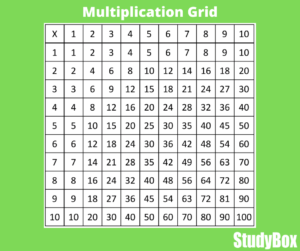
Assign a different colour to each times table. This helps visual learners spot patterns and makes the grid less overwhelming. Highlight matching pairs (e.g. 3 × 4 and 4 × 3 in the same colour) to show that learning one fact gives you two for free.
Every times table has patterns that make it easier to remember:
Write the question on one side and the answer on the other. Shuffle and test daily. Start with the ones your child finds hardest and gradually add easier ones. Flash cards are portable — perfect for practising in the car or before bed.
Musical multiplication — whether it’s a catchy YouTube video or a made-up rhyme — uses a different part of the brain. Many children remember “5, 6, 7, 8… 56 is 7 × 8” more easily than the raw numbers.
Five minutes of daily practice is far more effective than an hour once a week. Consistency builds long-term memory. Try testing a few facts at breakfast, in the car, or before bedtime.
Turn practice into a challenge rather than a chore:
Research shows that the 7 times table is the hardest for most children, followed by 8 and 6. This is because 7 is a prime number, so the multiples don’t follow obvious patterns.
By Year 4, most children have already learned their 2s, 3s, 4s, 5s and 10s — so the “new” facts to memorise are actually quite few. The trickiest ones tend to be:
Focus extra practice on these — if your child knows the harder facts, the rest will come easily.

Times tables aren’t just for primary school tests. Fluent recall helps with:
Investing time in times tables now pays dividends for years to come.
If your child is finding times tables a challenge, our experienced maths tutors can help them build fluency and confidence through personalised, step-by-step support.
We offer maths tuition for ages 5–17, covering everything from basic times tables to GCSE preparation.
Book a free trial at one of our tuition centres in Wallington, Sutton or Croydon, or call us on 0203 189 1442.
The best time to start tutoring depends on the reason for it. For catch-up support, the earlier the better — ideally as soon as you notice your child struggling, which is often in Year 2 or Year 3. For 11 Plus preparation, start in Year 4 (12-18 months before the exam). For GCSE preparation, Year 10 gives enough time to build foundations before the exam year.
The most important principle, backed by research from the Education Endowment Foundation, is that early intervention is always more effective than late intervention. A small gap in Year 2 becomes a large gap by Year 6 if left unaddressed.
Tuition at this age is unusual and generally not necessary unless a child has been identified as having specific learning difficulties or is significantly behind in early reading or numeracy. At this stage, parental support at home — reading together, counting games, letter recognition — is usually sufficient.
However, if your child’s teacher has flagged concerns about their development, or if they are markedly behind their peers, early support from a specialist can prevent problems from becoming entrenched. StudyBox accepts children from Year 1 (age 5), with sessions tailored to this age group.
This is the most valuable time to start tuition for a struggling child. Research from the Department for Education shows that children who are behind in reading at age 7 are six times less likely to reach the expected standard at age 11 than their peers. The same pattern holds for numeracy.
At this age, gaps are still small and relatively easy to close. A child who doesn’t understand place value in Year 2 can master it with a few weeks of targeted support. By Year 5, that same gap has grown to affect fractions, decimals, multiplication and division — requiring much more intensive work.
If your child is sitting the 11 Plus exam, Year 4 is the time to start preparation. The exam tests verbal reasoning and non-verbal reasoning — subjects not taught in most primary schools — so children need at least 12 months of structured practice to build these skills.
Even if your child is not taking the 11 Plus, Year 4 is when the curriculum gets noticeably harder. Fractions, long multiplication, grammar, and extended writing all become more demanding. Children who were coasting in Years 2-3 may start to struggle. Starting tuition at this point prevents gaps from widening into Year 6 and the SATs.
The Key Stage 2 SATs in May of Year 6 are the first high-stakes exams most children face. While schools provide preparation, tuition can help with specific weak areas and exam technique. Starting in September of Year 6 gives 8 months of preparation — enough time to make a significant difference.
Many parents stop tuition after the 11 Plus or SATs and don’t restart until GCSEs loom. But Years 7-9 are when students are building the foundations that GCSE success depends on. Algebra, trigonometry, essay writing, and scientific method are all introduced during Key Stage 3. A student who doesn’t understand algebra in Year 8 will struggle with 40% of the GCSE Maths paper.
If your child’s grades dip during Key Stage 3, or if they report that lessons are “confusing” or “boring” (often code for “I don’t understand”), this is the time to act — before GCSE coursework and exams add pressure.
For GCSE tuition, Year 10 is the ideal starting point. This gives a full year to build understanding before the intensity of Year 11. Starting in Year 11 is possible but means working under time pressure, which adds stress to an already stressful year.
GCSE tuition should focus on exam technique, past paper practice, and targeted revision of weak topics — not just re-teaching what the school has covered. A good tutor will identify the specific topics where your child drops marks and drill those areas intensively.
Start tutoring now if any of the following apply:
StudyBox welcomes students from age 5 to age 17 at our centres in Wallington, Sutton and Croydon. Every student starts with an assessment to identify exactly where they are and what they need, followed by a personalised learning plan. Our small groups (maximum 3 students per tutor) ensure your child gets focused, individual attention from day one.
Ready to start? Book a free trial session — it’s completely free and there’s no obligation to continue.
In-person tutoring is more effective for most children, particularly those under 14. A 2022 study published in the Journal of Educational Psychology found that students receiving in-person tuition showed 23% greater improvement in test scores compared to those receiving equivalent online tuition. The main advantages of in-person tutoring are a distraction-free environment, immediate feedback, and stronger tutor-student relationships.
Online tutoring works well for older, self-motivated students (Year 10+) who are comfortable with technology and can focus independently through a screen.
At a dedicated tuition centre, your child is in a space designed for learning — no siblings, no pets, no gaming console in the next room. This physical separation from home helps children associate the space with focused work. Research from the University of California found that environmental context strongly influences learning behaviour: children who study in a dedicated space outperform those who study where they also relax or play.
An in-person tutor can see your child’s body language, facial expressions, and handwriting in real time. They notice the furrowed brow that means “I don’t understand but I won’t ask,” the hesitation that means “I’m guessing,” and the confident nod that means “I’ve got this.” Through a screen, these signals are much harder to read, especially with younger children who may not articulate confusion verbally.
The tutor-student relationship is one of the most important factors in tuition effectiveness. In-person interaction builds trust, rapport and accountability more quickly than online sessions. A child who knows their tutor — who has sat next to them, shared a joke, celebrated their progress — is more motivated to try hard and ask for help.
Online tutoring requires reliable internet, a working device with a camera and microphone, and a child who can navigate the platform. Technical problems — frozen screens, audio lag, disconnections — waste valuable learning time and cause frustration. In-person tutoring has none of these issues.
Students in Year 10 and above who are preparing for GCSEs or A-Levels often have the maturity and self-discipline to learn effectively online. They can articulate their questions, stay focused through a screen, and use digital tools (shared whiteboards, document sharing) productively.
Families who live far from a good tuition centre may find online tutoring is their best option. The quality of online tuition has improved significantly since 2020, and for families with no local alternative, it is far better than no tuition at all.
Online tuition often offers more flexible scheduling, including evening and weekend slots, because the tutor doesn’t need to be physically present at a centre. For families with complex schedules (multiple children in different activities, long commutes), this flexibility can be valuable.
Multiple studies have raised concerns about the effectiveness of screen-based learning for younger children:
Ask yourself these questions:
StudyBox provides in-person tuition at dedicated centres in Wallington, Sutton and Croydon. Our centres are designed for focused learning, with small groups of no more than 3 students per tutor. Since 2014, we’ve helped over 6,000 students improve their confidence and results in Maths, English and Science.
See the difference in-person tuition makes. Book a free trial session at your nearest StudyBox centre.