Subtracting fractions is one of the trickier topics in primary school maths, but it follows a clear set of rules. Once your child understands the method, they can apply it to any subtraction — whether the denominators are the same, different, or the fractions are mixed numbers. This guide breaks it down step by step.
The Key Rule: Denominators Must Be the Same
Before you can subtract fractions, the denominators (bottom numbers) must match. This is the single most important rule to remember:
- If the denominators are already the same → subtract the numerators (top numbers) directly.
- If the denominators are different → find a common denominator first, then subtract.
Step 1: Subtracting Fractions with the Same Denominator
When both fractions have the same denominator, subtraction is straightforward — simply subtract the numerators and keep the denominator the same.
Example 1
5/8 − 3/8 = ?
- Denominators are the same (8), so subtract the numerators: 5 − 3 = 2.
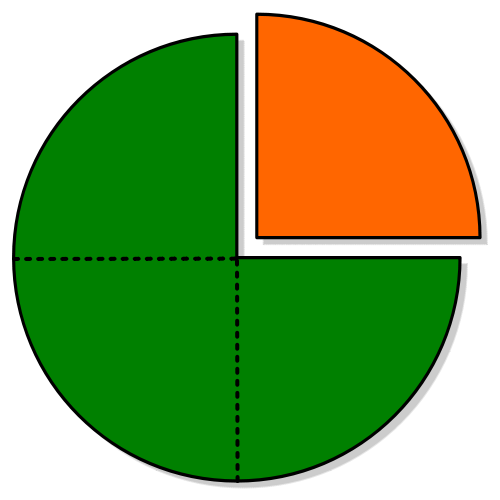
- Answer: 2/8, which simplifies to 1/4.
Example 2
7/10 − 2/10 = ?
- Subtract the numerators: 7 − 2 = 5.
- Answer: 5/10, which simplifies to 1/2.
Step 2: Subtracting Fractions with Different Denominators
When the denominators are different, you need to find a common denominator — a number that both denominators divide into evenly. The easiest method is to find the lowest common multiple (LCM) of the two denominators.
Example 3
3/4 − 1/3 = ?
- Find the LCM of 4 and 3. The LCM is 12.
- Convert both fractions:
- 3/4 → multiply top and bottom by 3 → 9/12
- 1/3 → multiply top and bottom by 4 → 4/12
- Subtract: 9/12 − 4/12 = 5/12.
Example 4
5/6 − 1/4 = ?
- LCM of 6 and 4 is 12.
- Convert:
- 5/6 → multiply by 2 → 10/12
- 1/4 → multiply by 3 → 3/12
- Subtract: 10/12 − 3/12 = 7/12.
Step 3: Subtracting Mixed Numbers
A mixed number has a whole number part and a fraction part (like 2 1/3). To subtract mixed numbers:
Method A: Convert to Improper Fractions
- Convert each mixed number to an improper fraction.
- Find a common denominator if needed.
- Subtract.
- Convert back to a mixed number.
Example 5
3 1/2 − 1 3/4 = ?
- Convert: 3 1/2 = 7/2 and 1 3/4 = 7/4.
- Common denominator (4): 7/2 = 14/4.
- Subtract: 14/4 − 7/4 = 7/4.
- Convert back: 7/4 = 1 3/4.
Method B: Subtract Whole Numbers and Fractions Separately
Sometimes it is simpler to subtract the whole numbers first, then the fractions:
Example 6
4 2/5 − 2 1/5 = ?
- Whole numbers: 4 − 2 = 2.
- Fractions: 2/5 − 1/5 = 1/5.
- Answer: 2 1/5.
This method works well when the first fraction is larger than the second. If not (e.g., 3 1/4 − 1 3/4), you need to borrow from the whole number, which is where Method A is simpler.
Subtracting a Fraction from a Whole Number
To subtract a fraction from a whole number, convert the whole number into a fraction first:
Example 7
3 − 2/5 = ?
- Convert 3 to fifths: 3 = 15/5.
- Subtract: 15/5 − 2/5 = 13/5 = 2 3/5.
Always Simplify Your Answer
After subtracting, check whether your answer can be simplified by dividing the numerator and denominator by their highest common factor:
- 6/8 → divide both by 2 → 3/4
- 4/10 → divide both by 2 → 2/5
- 9/12 → divide both by 3 → 3/4
Common Mistakes to Avoid
- Subtracting the denominators. Only the numerators are subtracted — the denominator stays the same (or becomes the common denominator).
- Forgetting to convert. If the denominators are different, you must find a common denominator before subtracting.
- Not simplifying. Always check if your answer can be reduced to its simplest form.
- Converting mixed numbers incorrectly. To convert 2 3/4 to an improper fraction: (2 × 4) + 3 = 11, so it is 11/4.
Practice Problems
Try these at home with your child:
Same Denominator
- 7/9 − 4/9 = ? (Answer: 3/9 = 1/3)
- 11/12 − 5/12 = ? (Answer: 6/12 = 1/2)
Different Denominators
- 3/4 − 1/6 = ? (Answer: 9/12 − 2/12 = 7/12)
- 2/3 − 1/5 = ? (Answer: 10/15 − 3/15 = 7/15)
Mixed Numbers
- 4 1/3 − 2 1/6 = ? (Answer: 2 1/6)
- 5 − 2 3/8 = ? (Answer: 2 5/8)
Related Reading
How StudyBox Can Help
Fractions are one of the topics our maths tutors work on most with KS2 students. At StudyBox, we break down every step, use visual aids to build understanding, and give children plenty of practice until the method becomes second nature.
Book a free trial lesson at one of our centres in Wallington, Sutton, or Croydon.